
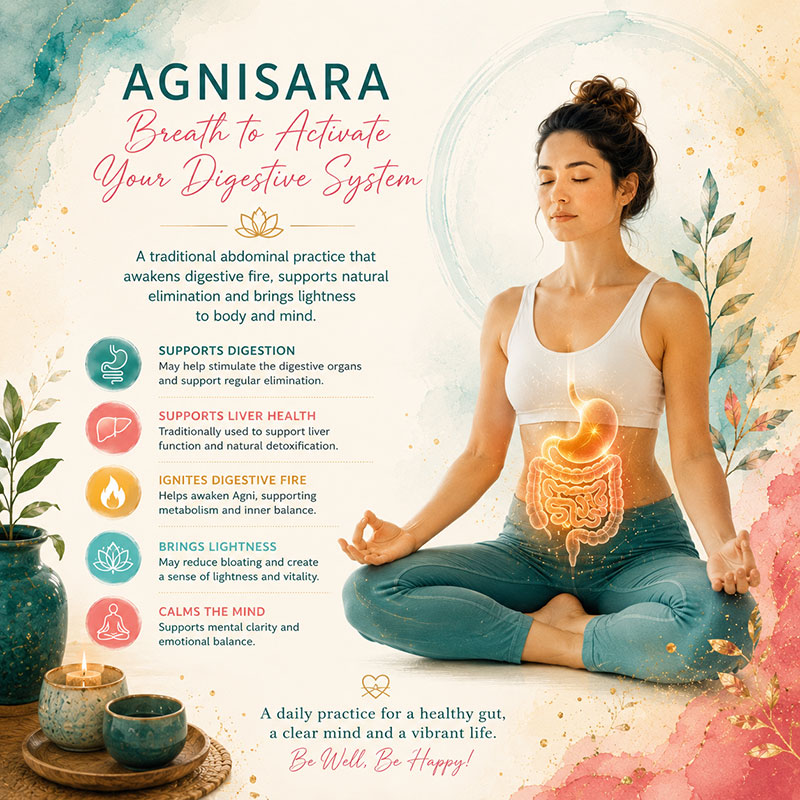
Breathing Exercise for Activating the Digestive System
Agnisara is a traditional yogic abdominal practice designed to awaken awareness around the digestive region and stimulate rhythmic movement in the abdominal wall.
When practised safely and without strain, it may complement a balanced lifestyle by supporting digestive awareness, abdominal muscle coordination and metabolic vitality.
Agnisara combines external breath retention with repeated abdominal movement. It should be learned gradually, practised on an empty stomach and stopped immediately if it causes discomfort.
Review the Contraindications and Application Video
Before practising any pranayama or yogic abdominal technique described in Ebru Şinik’s breathing guide, review its specific instructions and contraindications.
Agnisara is not a conventional slow-breathing exercise. It involves holding the breath comfortably after exhalation while repeatedly drawing the abdomen inwards and releasing it.
Because this action changes pressure within the abdominal region, learning the practice directly from an experienced instructor is preferable.
Watching the complete application video before your first attempt can help you understand the breathing sequence, abdominal movement and resting phase.
What Is Agnisara?
The Sanskrit word Agni refers to fire, while sara is associated with essence, movement or activation.
In Ayurveda and traditional yoga, Agni represents the body’s digestive and transformative capacity.
Agnisara uses rhythmic abdominal contractions to create movement and awareness around the abdomen, diaphragm and digestive region.
Agnisara Is More Than a Breathing Exercise
Although Agnisara is often introduced within pranayama programmes, the principal action is created by the abdominal muscles rather than by repeated inhalation and exhalation.
The breath is first released. While the breath remains comfortably outside the body, the abdomen is drawn towards the spine and released several times.
The practice ends before strain develops. The abdomen is then relaxed and inhalation resumes gently through the nose.
Position
Sit upright on the floor or on a stable chair in a quiet and secure environment.
Age
This breath-retention practice is generally not recommended for children below adolescence.
Empty Stomach
Practise before eating or only after the previous meal has been fully digested.
Frequency
One short, controlled daily practice is sufficient for beginners.
Do Not Practise While Driving or Travelling
Breath retention and repeated abdominal contractions may occasionally cause light-headedness or discomfort.
Do not practise while driving, operating equipment or sitting in a moving vehicle where you cannot stop and rest safely.
Choose a quiet, well-ventilated place where you can remain seated and allow your normal breathing rhythm to return before standing.
Important Contraindications
Do not practise Agnisara without individual medical and professional guidance when any of the following situations apply:
- A full stomach or immediately after a main meal
- Pregnancy
- Uncontrolled high blood pressure
- Heart or significant cardiovascular disease
- Dizziness, fainting or breath-retention intolerance
- Acute abdominal pain or unexplained digestive symptoms
- Ascites
- Abdominal, inguinal or hiatal hernia
- Active gastritis, stomach or duodenal ulcer
- Recent abdominal or stomach surgery
- Heavy or painful menstruation when abdominal contractions feel uncomfortable
- Any condition for which breath holding or abdominal pressure is restricted
Stop immediately if you experience pain, dizziness, nausea, chest discomfort, visual disturbance, panic or unusual shortness of breath.
What May Agnisara Support?
Scientific research specifically examining Agnisara remains limited. The practice should therefore be presented as a supportive wellbeing technique rather than a treatment for digestive or metabolic disease.
Abdominal Muscle Awareness
The repeated inward and outward movement may improve awareness and coordination of the abdominal muscles.
Digestive Awareness
Rhythmic abdominal movement may create a greater sense of activity and awareness around the digestive region.
Metabolic Vitality
In traditional Ayurveda, Agnisara is used to awaken Agni—the body’s digestive and transformative fire.
Diaphragm and Core Awareness
The practice may strengthen awareness of the relationship between the abdomen, diaphragm, posture and breath.
Abdominal Circulation
The change in abdominal pressure may create a temporary increase in blood flow around the digestive region.
Daily Digestive Routine
A short morning practice may encourage greater awareness of digestion, hydration, meal timing and regular daily habits.
Agnisara Is Not a Medical Treatment
Agnisara should not be described as a treatment for hepatitis, diabetes, fatty liver disease, chronic constipation or disorders of the pancreas, liver or intestines.
Persistent constipation or another digestive complaint may have many different causes and requires appropriate medical evaluation.
Use the practice only as a supportive wellbeing tool alongside adequate hydration, fibre-rich nutrition, regular movement and professional care when needed.
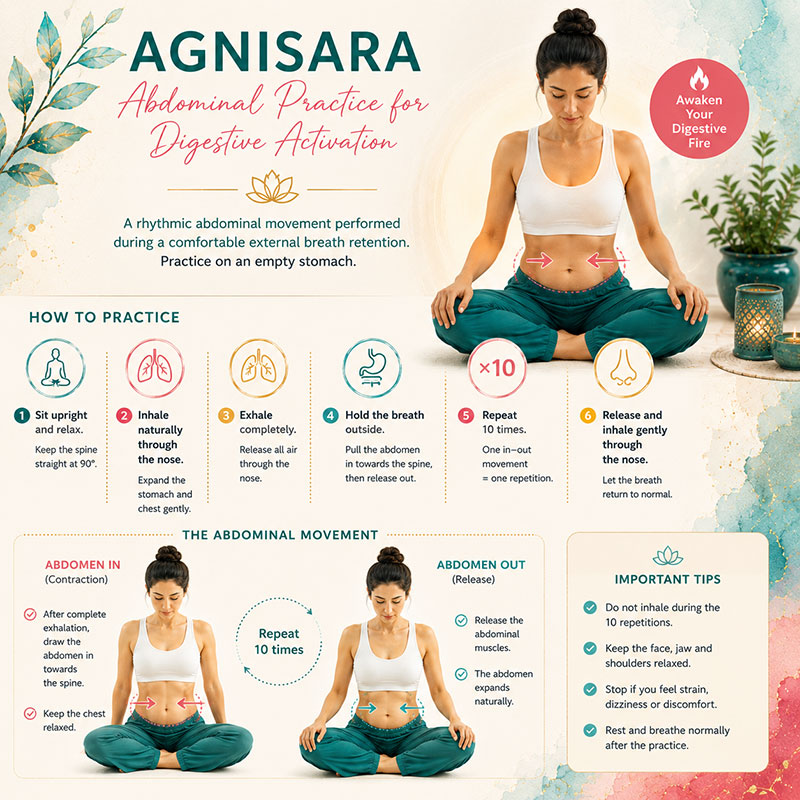
Prepare a Comfortable Sitting Position
Sit on the floor with the pelvis slightly elevated, or choose a firm chair that allows you to keep both feet supported.
Keep the spine upright without becoming rigid. Relax the face, jaw, neck and shoulders.
The abdomen should remain free to move. Avoid tight clothing or any posture that compresses the stomach.
How to Practise Agnisara
Begin with a small number of abdominal movements. The practice should end before you feel an urgent need to breathe.
Sit Upright and Relax
Settle into a stable sitting position. Keep the eyes softly closed and allow the shoulders and jaw to relax.
Take a Natural Inhalation
Breathe in naturally through the nose without trying to fill the lungs to their maximum capacity.
Exhale Completely
Exhale gently but fully through the nose or mouth, according to the method taught by your instructor.
Hold the Breath Outside
Without inhaling again, remain in a comfortable external breath retention. Do not close the throat forcefully.
Draw the Abdomen In
Pull the abdominal wall gently towards the spine without collapsing the chest or tightening the face.
Release the Abdomen
Allow the abdominal wall to move outwards again while continuing to hold the breath comfortably outside.
Repeat Five to Ten Times
Beginners may repeat the inward and outward movement five times. Progress towards ten only when the entire round remains easy.
Release and Inhale Gently
Stop the abdominal movement, relax the belly completely and inhale gently through the nose before the breath hold becomes urgent.
Rest After Each Round
Let the breath return fully to its normal rhythm after completing the abdominal movements.
Keep the eyes closed and observe the abdomen, heartbeat and breathing before beginning another round.
One well-controlled round may be sufficient. Never begin another round while you still feel breathless, dizzy or unsettled.
A Gentle Way to Begin
First Week
Complete one round with approximately five gentle abdominal movements.
When Comfortable
Gradually progress towards ten abdominal movements within one comfortable retention.
With Guidance
Additional rounds should be introduced only after the basic movement has been checked by a qualified instructor.
The number of abdominal movements is never more important than comfort. End the breath retention before it becomes a struggle.
Watch the Agnisara Application Video
Watch Ebru Şinik’s complete demonstration before your first practice to observe the breath retention, abdominal movement, posture and resting phase.
Watch the Application VideoLife Hidden in Breath
Ebru Şinik’s book Life Hidden in Breath – Breathing Techniques for Daily Life, presented on its English cover as Health, Breath & Life, explains breathing and abdominal practices step by step.
The book includes application guidance, recommended durations, technique-specific contraindications and QR-coded instructional videos.
Review the complete guidance before selecting practices that are suitable for your body, health history and personal wellbeing needs.
Discover the Breathing GuideBe Well, Be Happy!
Agnisara and Digestive Awareness
What is Agnisara?
Agnisara is a traditional yogic abdominal practice involving repeated inward and outward movement of the abdomen during a comfortable breath retention after exhalation.
Is Agnisara a pranayama technique?
It is often taught alongside pranayama, but it is more accurately described as a yogic abdominal or cleansing practice because abdominal movement is its main action.
Should the breath be held after inhalation or exhalation?
In the classical application, the breath is released first and the abdominal movements are performed during a comfortable external breath retention.
Can Agnisara help with constipation?
Rhythmic abdominal movement may support digestive awareness and a regular wellbeing routine, but Agnisara is not a proven treatment for chronic constipation. Persistent symptoms require medical evaluation.
Can Agnisara treat diabetes or liver disease?
No. Agnisara does not replace medication, nutritional therapy or professional care for diabetes, hepatitis, fatty liver disease or another medical condition.
Can Agnisara be practised after eating?
No. Practise only on an empty or fully digested stomach. Do not perform abdominal contractions immediately after a meal.
Can I practise Agnisara while travelling?
Do not practise while driving or in a situation where dizziness would create a safety risk. Choose a stable, quiet place where you can rest afterwards.
How many abdominal movements should beginners perform?
Beginners may start with approximately five gentle movements in one round. Increase only when the breath retention remains easy and completely free of strain.
What should I do if I feel dizzy?
Stop the abdominal movement immediately, relax the belly and return to normal breathing. Rest and do not resume the practice during the same session.
Wellbeing Note
Agnisara includes external breath retention and repeated changes in abdominal pressure. It should not be treated as an ordinary relaxation exercise.
Anyone with cardiovascular, abdominal, digestive or breath-retention-related health concerns should obtain individual medical and professional guidance before practising.
Ebru Şinik
Wellbeing Coach & Ayurveda Instructor