
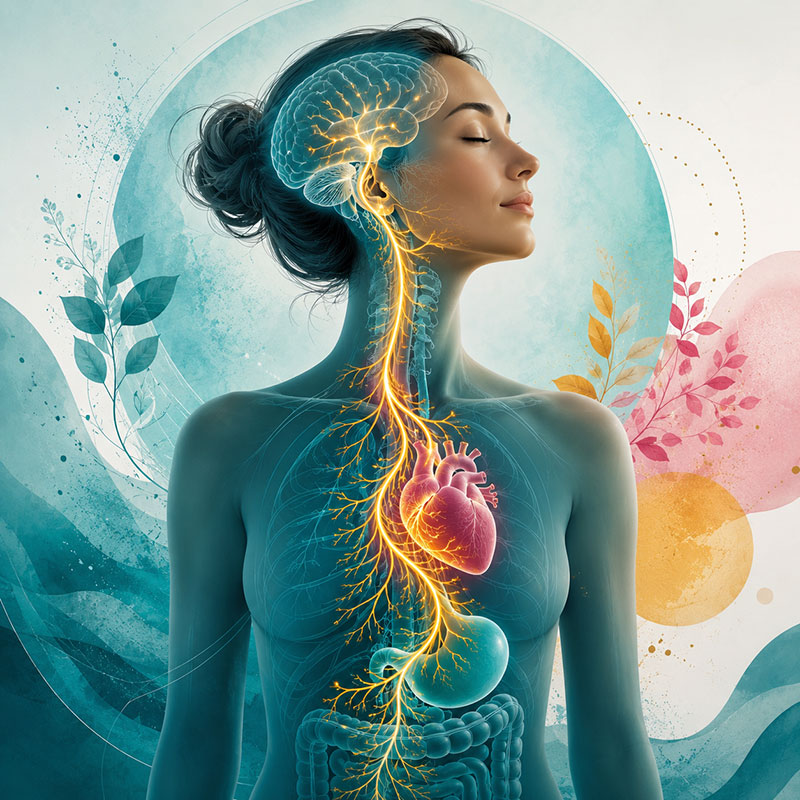
The Vagus Nerve: A Vital Connection Between the Brain and Body
Have you ever heard of the vagus nerve? This extensive nerve network carries information between the brain and many of the body’s internal organs.
It contributes to the regulation of heart rate, respiration, digestion, swallowing, vocal function and the body’s transition from activation towards rest.
The vagus nerve is not a magical switch for happiness. It is an important part of the complex communication system through which the brain and body continuously influence one another.
What Is the Vagus Nerve?
The vagus nerve is the tenth cranial nerve. Its name is derived from the Latin word meaning “wandering,” reflecting the wide route it follows throughout the body.
There is a right and a left vagus nerve. Both arise from the brainstem and travel through the neck before extending into the chest and abdominal region.
The vagus contains sensory, motor and parasympathetic fibres. A large proportion of its communication carries information from internal organs towards the brain, while other fibres carry regulatory signals from the brain towards the body.
It is therefore more accurate to think of the vagus nerve as a two-way communication network rather than a single relaxation button.
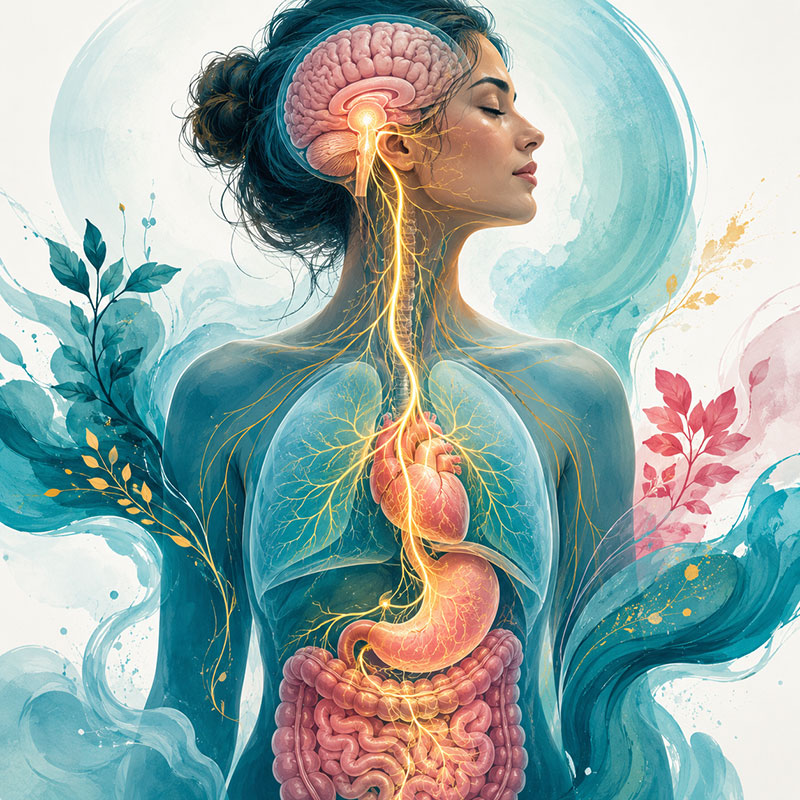
Where Does the Vagus Nerve Travel?
The vagus nerve begins in the brainstem and passes through the neck, where it contributes to functions involving the throat, larynx, swallowing and voice.
It then extends through the chest, forming connections associated with the heart and lungs.
Continuing through the diaphragm, it reaches many organs of the digestive system, including the stomach and sections of the intestines.
The Vagus Nerve and the Parasympathetic Nervous System
The autonomic nervous system helps regulate many involuntary functions, including heart rate, blood pressure, breathing and digestion.
Its sympathetic division supports mobilisation during challenge or threat, while the parasympathetic division contributes to recovery, digestion and energy conservation.
The vagus nerve is a principal pathway of parasympathetic communication between the brain and many organs in the chest and abdomen.
These systems are not enemies. Health depends on the ability to activate when necessary and return towards recovery when the challenge has passed.
Functions Associated with the Vagus Nerve
Heart-Rate Regulation
Vagal signals contribute to slowing and regulating the heart after periods of physiological activation.
Respiratory Communication
The vagus carries sensory information from the respiratory system and participates in reflexes involving the airways.
Digestion
Vagal communication contributes to digestive movement, secretion and the signalling exchanged between the gastrointestinal system and the brain.
Voice and Swallowing
Branches of the vagus nerve contribute to the coordinated movement of structures involved in speech and swallowing.
Protective Reflexes
The vagus participates in reflexes such as coughing, gagging and certain responses to changes within internal organs.
Brain–Body Feedback
Sensory signals carried towards the brain provide continuous information about the state of the internal organs.
What Happens During Stress?
During a stressful situation, the body may increase heart rate, muscle tension and alertness while temporarily changing digestive activity.
This does not mean that the vagus nerve has been switched off or damaged. It means that autonomic regulation has temporarily shifted towards mobilisation.
When the challenge has passed, parasympathetic processes help the body move towards recovery. The ability to shift flexibly between activation and recovery is more important than remaining relaxed at all times.
The Vagus Nerve and Homeostasis
Homeostasis describes the body’s ability to maintain relatively stable internal conditions while responding to changes in the environment.
The vagus nerve contributes to this wider regulatory process by carrying information between the brain and internal organs.
It does not regulate every organ on its own. Homeostasis depends on coordinated activity across the nervous, endocrine, cardiovascular, respiratory, immune and digestive systems.
What Is Heart Rate Variability?
Heart rate variability, commonly abbreviated as HRV, refers to variation in the time interval between consecutive heartbeats.
Certain HRV measurements are influenced by cardiac parasympathetic activity and respiration.
However, a single smartwatch reading cannot diagnose the overall health of the vagus nerve. HRV is affected by breathing, activity, sleep, age, medication, illness and many other variables.
Is the Vagus Nerve Responsible for Happiness and Empathy?
The vagus nerve participates in brain–body pathways associated with emotional and social functioning, but happiness, empathy and decision-making cannot be reduced to the condition of a single nerve.
Mood and social connection arise through interactions among the brain, nervous system, hormones, personal experience, physical health, environment and relationships.
Low HRV or altered autonomic function may be associated with certain health conditions, but this does not mean that vagal dysfunction alone causes depression, panic attacks, fibromyalgia, obesity or neurodegenerative disease.

What Can Support Parasympathetic Regulation?
No everyday exercise can guarantee a “reset” of the vagus nerve. However, several sustainable practices may support relaxation, autonomic flexibility and general wellbeing.
The objective is not to force the nervous system into constant calmness, but to help the body move more effectively between activity, rest and recovery.
Slow and Comfortable Breathing
Gentle breathing at a slower rhythm may influence heart-rate patterns and support parasympathetic regulation.
Humming and Chanting
Gentle humming naturally extends exhalation and creates vibration in the throat and facial area. It may feel calming for some people.
Regular Physical Movement
Walking and other appropriate physical activities support cardiovascular health, sleep, mood and autonomic regulation.
Laughter and Social Connection
Safe and supportive relationships, shared laughter and meaningful connection can contribute to emotional wellbeing.
Yoga, Tai Chi and Qigong
Practices that combine movement, attention and regulated breathing may support relaxation and body awareness.
Sleep and Daily Rhythm
Consistent sleep, regular meals, recovery time and sustainable routines support the wider nervous system.
A Simple Way to Slow Down
This is a gentle awareness practice rather than a forceful pranayama exercise.
Sit Comfortably
Sit upright without becoming rigid. Relax the face, jaw and shoulders.
Breathe Gently
Inhale comfortably through the nose without trying to take the largest possible breath.
Lengthen the Exhalation
Allow the exhalation to become slightly longer than the inhalation while remaining natural and completely free of strain.
Continue for approximately three to five minutes. Stop if you feel dizzy, breathless, anxious or uncomfortable.
Do All Breathing Techniques Affect the Body in the Same Way?
No. Slow techniques such as gentle diaphragmatic breathing may be relaxing, while faster practices such as Kapalabhati and Bhastrika can be stimulating.
Ujjayi and Bhramari combine controlled breathing with sound or throat sensation, but their effects and suitability vary from person to person.
Choose each technique according to its specific instructions and contraindications. A practice described as “vagus stimulating” is not automatically suitable for every health condition.
What Should We Be Careful Not to Claim?
The Vagus Nerve Is Not the Right Side of the Brain
It is a pair of cranial nerves arising from the brainstem, not a cerebral hemisphere.
Low HRV Is Not a Diagnosis
HRV varies for many reasons and cannot independently diagnose vagus nerve damage or a psychological disorder.
Crying Is Not a Vagus-Nerve Treatment
Crying may provide emotional release, but it should not be presented as a proven method for treating vagal dysfunction.
Tongue Cleaning Does Not Cure Vagal Disorders
Tongue cleaning may be included in oral-care or Ayurvedic routines, but it is not an established treatment for vagus nerve damage.
Everyday Practices Are Not the Same as Medical Vagus Nerve Stimulation
Clinical vagus nerve stimulation uses specialised implanted or external medical devices to deliver electrical stimulation according to a defined protocol.
This is fundamentally different from breathing, humming, yoga or relaxation exercises.
Do not attempt electrical vagus nerve stimulation with an unapproved consumer device or improvised method. Medical neuromodulation requires professional assessment and supervision.
When Should You Seek Professional Support?
Symptoms such as fainting, persistent difficulty swallowing, unexplained changes in voice, severe digestive dysfunction, chest pain or abnormal heart rhythms should not be self-diagnosed as “low vagal tone.”
These symptoms may have many different causes and require appropriate medical assessment.
Supporting the nervous system is not about finding a single switch. It is about creating sustainable rhythms of breathing, movement, sleep, connection and recovery.
Be Well, Be Happy!
The Vagus Nerve and Mind-Body Balance
What is the vagus nerve?
The vagus nerve is the tenth cranial nerve. It carries sensory, motor and parasympathetic signals between the brainstem and structures in the neck, chest and abdomen.
Is there only one vagus nerve?
No. There is a right and a left vagus nerve, with branches extending through both sides of the body.
Is the vagus nerve part of the right side of the brain?
No. It is a cranial nerve that arises from the brainstem. It is not the right hemisphere of the brain.
What does the vagus nerve regulate?
It contributes to functions involving heart rate, digestion, swallowing, vocal function, respiratory reflexes and communication between internal organs and the brain.
Does slow breathing stimulate the vagus nerve?
Slow, comfortable breathing can influence heart-rate variability and parasympathetic regulation. It is more accurate to describe this as supporting autonomic regulation than directly switching the nerve on.
Does humming support relaxation?
Humming naturally prolongs exhalation and creates vibration in the throat and nasal region. Some people find it calming, although individual responses vary.
Can I measure vagal tone with a smartwatch?
Wearable devices can estimate certain HRV measurements, but a single value does not provide a complete assessment of vagus nerve health.
Does vagus nerve dysfunction cause depression or obesity?
These conditions are influenced by many biological, psychological, social and environmental factors. They cannot be attributed to vagal activity alone.
Are everyday relaxation practices the same as medical VNS?
No. Medical vagus nerve stimulation uses specialised electrical devices and defined clinical protocols. Breathing, humming and yoga are supportive wellbeing practices.
Can vagus nerve exercises prevent most diseases?
No. Nervous-system regulation may support overall wellbeing, but no breathing or vagus-focused exercise can prevent or cure 95 percent of diseases.
Wellbeing Note
Slow breathing, humming, mindful movement and supportive relationships may contribute to relaxation and autonomic regulation.
These practices do not diagnose, prevent or treat vagus nerve damage, depression, anxiety disorders, fibromyalgia, Alzheimer’s disease, obesity or another medical condition.
Ebru Şinik
Wellbeing Coach & Ayurveda Instructor